
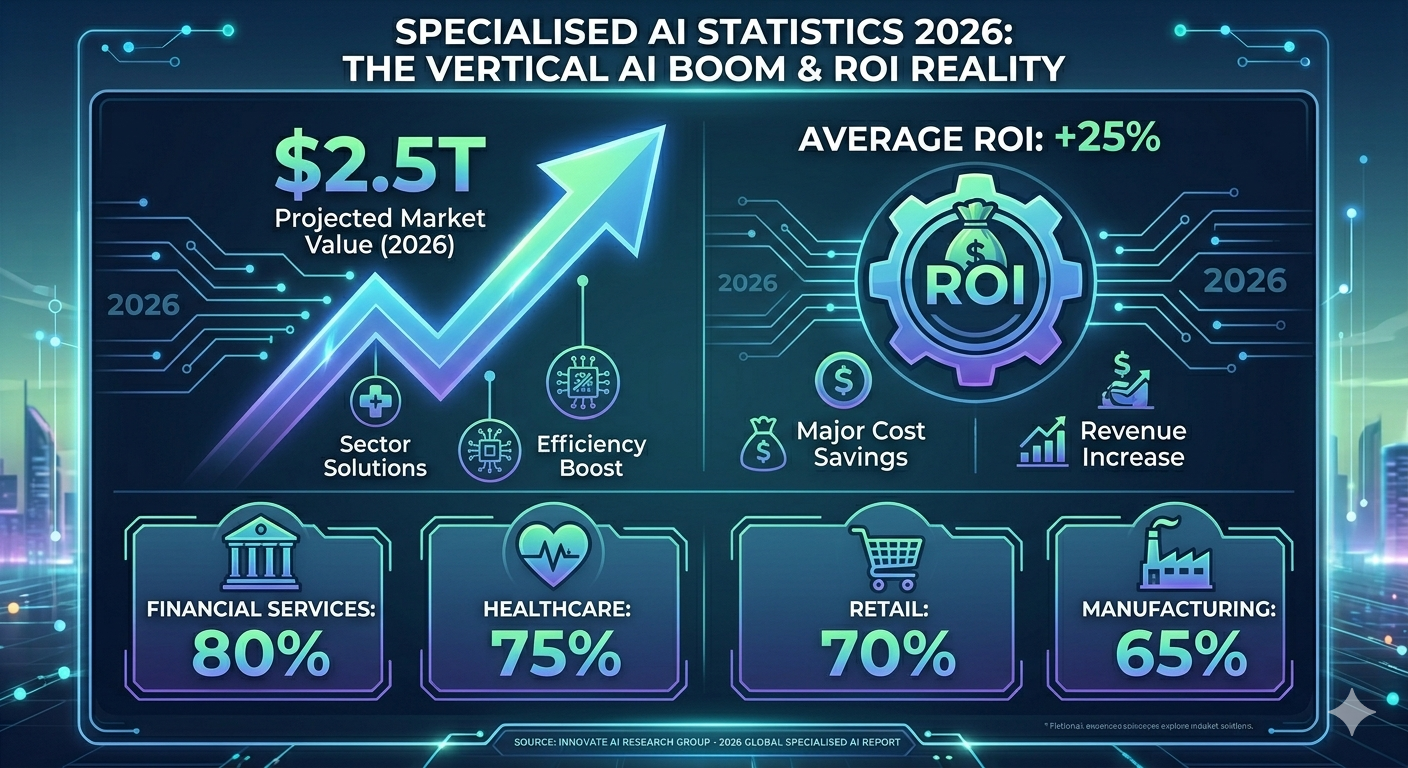
The defining shift in enterprise AI between 2024 and 2026 is not a smarter foundation model — it is the widening gap between firms that deploy general-purpose chatbots and those that deploy specialised intelligence. Vertical AI investment tripled to USD 3.5 billion in 2025 (Menlo Ventures), only 6% of organisations capture meaningful EBIT from AI (McKinsey), and Gartner now forecasts that 40% of enterprise applications will embed task-specific AI agents by the end of 2026, up from less than 5% in 2025.
This roundup aggregates 50+ statistics from primary Tier 1 and Tier 2 sources — Stanford HAI, McKinsey, Gartner, IDC, Forrester, Deloitte, BCG, IBM IBV, Menlo Ventures, MIT NANDA, Bessemer Venture Partners, Euclid Ventures, the World Economic Forum, the European Commission, NIST, IEA, ONS, Vals AI and peer-reviewed research from arXiv, ACL Anthology and NeurIPS — to give senior decision-makers a single citation-ready reference for vertical AI, domain-specific models and agentic adoption in 2026.
Key Takeaways
- 88% of organisations now use AI in at least one function, but only 6% are AI high-performers attributing more than 5% of EBIT to AI (McKinsey, State of AI in 2025).
- 95% of enterprise generative AI pilots delivered no measurable P&L impact (MIT NANDA, State of AI in Business 2025).
- Vertical AI investment reached USD 3.5 billion in 2025, nearly 3× the prior year (Menlo Ventures).
- 76% of enterprise AI use cases are now bought rather than built, up from 53% in 2024 (Menlo Ventures, 2025).
- 40% of enterprise applications will embed task-specific AI agents by end-2026, up from <5% in 2025 (Gartner, August 2025).
- Over 40% of agentic AI projects will be cancelled by end-2027 (Gartner, June 2025).
- Vertical AI's market capitalisation will be at least 10× the size of legacy vertical SaaS (Bessemer Venture Partners, Building Vertical AI).
- 74% of companies expect to use agentic AI moderately or extensively within two years, up from 23% today (Deloitte, State of AI in the Enterprise 2026).
- EU AI Act high-risk obligations become enforceable from 2 August 2026, with fines up to EUR 35 million or 7% of global turnover (European Commission).
- Only 21% of companies report a mature governance model for autonomous agents (Deloitte, 2026).
- Enterprise LLM spend grew from USD 4.5M per company in 2023 to USD 7M in 2025 (a16z, 2025).
- 84% of developers use AI tools, but only 29% trust their accuracy (Stack Overflow Developer Survey 2025).
1. The AI Value Gap: Adoption is universal, value is rare
Adoption has saturated at the same time financial impact has flatlined. The data from McKinsey, BCG, MIT and IBM converges on the same direction even when the precise headline figures vary.
| Metric | Value | Source |
|---|---|---|
| Organisations using AI in ≥1 business function | 88% (n=1,993, 105 countries) | McKinsey, State of AI in 2025, Nov 2025 |
| Organisations classed as "AI high-performers" (>5% of EBIT from AI) | 6% | McKinsey, State of AI in 2025, Nov 2025 |
| Respondents reporting any enterprise-level EBIT impact from AI | 39% | McKinsey, State of AI in 2025 |
| Companies "future-built" — capturing AI value at scale | 5% (n=1,250) | BCG, Build for the Future 2025 |
| Companies reporting "little to no value" from AI investment | 60% | BCG, Build for the Future 2025 |
| Future-built firms' revenue growth vs laggards | 1.7× | BCG, Build for the Future 2025 |
| Future-built firms' three-year total shareholder return vs laggards | 3.6× | BCG, Build for the Future 2025 |
| Generative AI pilots with no measurable P&L impact | 95% | MIT NANDA, State of AI in Business 2025 |
| AI initiatives delivering expected ROI | 25% (n=2,000 CEOs) | IBM IBV, 2025 CEO Study |
The pattern is consistent: roughly 5–6% of organisations are extracting transformative value, while the remainder remain exposed to McKinsey's "gen AI paradox" — near-universal deployment with minimal earnings contribution.
2. Specialised AI: Spend, growth and the buy-vs-build shift
The 2025 enterprise generative AI market reached USD 37 billion, growing 3.2× year-on-year — but vertical and industry-specific applications grew faster than every other layer of the stack.
| Metric | Value | Source |
|---|---|---|
| Total enterprise generative AI spend, 2025 | USD 37 billion (3.2× YoY) | Menlo Ventures, 2025 State of GenAI in the Enterprise |
| Vertical / industry-specific AI spend, 2025 | USD 3.5 billion (≈3× YoY) | Menlo Ventures, 2025 |
| Healthcare share of vertical AI spend | USD 1.4–1.5 billion (≈43%) | Menlo Ventures, 2025 |
| Enterprise AI use cases bought vs built (2025) | 76% bought / 24% built | Menlo Ventures, 2025 |
| Enterprise AI use cases bought vs built (2024) | 53% / 47% | Menlo Ventures, 2025 |
| AI pilot-to-production conversion vs traditional SaaS | ~47% vs ~25% | Menlo Ventures, 2025 |
| Vertical AI's projected market cap vs legacy vertical SaaS | ≥10× | Bessemer Venture Partners, Building Vertical AI, Jan 2026 |
| LLM-native vertical AI YoY growth (Bessemer portfolio) | ~400% | Bessemer, State of AI 2025 |
| Bessemer "Supernova" cohort revenue per FTE | ~USD 1.13 million | Bessemer, State of AI 2025 |
| Vertical AI deals in late-stage VC (USD 100M+), per quarter | 55–57 (stable through 2025) | Euclid Ventures, Vertical Report 2026 |
| B2B software exits already vertical in nature | >50% | Euclid Ventures, 2026 |
Vertical AI companies operate at SaaS-grade margins (~65% gross margin, per Bessemer) while addressing labour budgets that are an order of magnitude larger than legacy software TAM. The buy-vs-build shift is the operational signal: enterprises now overwhelmingly buy specialised vertical solutions rather than build horizontal ones, which is why mid-market firms increasingly partner with consultancies — including Brainpool's GenAI for Business practice — that deploy domain-trained systems rather than wrap a foundation model in a chatbot interface.
3. Domain-Specific Models: The supply side of the specialised stack
The model layer is bifurcating. Specialised, domain-tuned models are growing roughly 2× faster than foundation models, and peer-reviewed research consistently shows that fine-tuned smaller models can match or beat frontier general-purpose models on domain-specific tasks at a fraction of the inference cost.
| Metric | Value | Source |
|---|---|---|
| Worldwide end-user spend on GenAI models, 2025 | USD 14.2 billion | Gartner, GenAI Models Forecast, July 2025 |
| Spend on specialised / domain-specific language models, 2025 | USD 1.1 billion (~8% of GenAI model spend) | Gartner, July 2025 |
| Specialised model spend YoY growth, 2025 | +279.2% (USD 302M → USD 1.1B) | Gartner, July 2025 |
| Foundation model spend YoY growth, 2025 | +141% | Gartner, July 2025 |
| Forecast share of enterprise GenAI from domain-specific models, 2027 | >50% (vs 1% in 2024) | Gartner, July 2025 |
| Worldwide AI infrastructure spend forecast, 2029 | USD 758 billion (94.3% accelerated servers) | IDC, AI Infrastructure Tracker, 2025 |
| Enterprises using ≥3 LLM families in production or testing | 81% | a16z, How 100 Enterprise CIOs Are Building and Buying Gen AI in 2025 |
| Anthropic share of enterprise LLM API market by spend, 2025 | 40% (up from 12% in 2023) | Menlo Ventures, 2025 |
| OpenAI share of enterprise LLM API market by spend, 2025 | 27% (down from ~50% in 2023) | Menlo Ventures, 2025 |
Predibase's evaluation of more than 700 fine-tuned open-source LLMs found fine-tuned smaller models surpassed GPT-4 on the majority of specialised tasks — the technical foundation of the specialisation thesis, and the reason most production-grade enterprise AI automation work in 2026 starts with a domain-tuned smaller model rather than the largest frontier general-purpose system available.
4. Agentic AI: From buzz to embedded enterprise infrastructure
Agentic AI is now the dominant 2026 enterprise framing. Adoption forecasts are aggressive — but Gartner, Forrester and McKinsey all flag that the failure rate will be high.
| Metric | Value | Source |
|---|---|---|
| Enterprise apps embedding task-specific AI agents by end-2026 | 40% (up from <5% in 2025) | Gartner, Aug 2025 |
| Enterprise software apps including agentic AI by 2028 | 33% (up from <1% in 2024) | Gartner, 2025 |
| Day-to-day work decisions made autonomously by agentic AI by 2028 | ≥15% (up from 0% in 2024) | Gartner, 2025 |
| Agentic AI projects forecast to be cancelled by end-2027 | >40% | Gartner, June 2025 |
| Vendors marketing agentic AI considered "real" by Gartner | ~130 (of thousands) | Gartner, June 2025 |
| Organisations scaling AI agents in ≥1 function | 23% (62% experimenting) | McKinsey, State of AI in 2025 |
| Companies using agentic AI moderately+ today | 23% (n=3,235) | Deloitte, State of AI in the Enterprise 2026 |
| Companies expecting agentic AI use within 2 years | 74% | Deloitte, 2026 |
| Companies with mature autonomous-agent governance | 21% | Deloitte, 2026 |
| CEOs actively adopting AI agents at scale | 61% (n=2,000) | IBM IBV, 2025 CEO Study |
| Best-case agentic AI share of enterprise software revenue by 2035 | ~30% (>USD 450 billion) | Gartner, 2025 |
McKinsey's Seizing the Agentic AI Advantage (June 2025) reports concrete outcomes: a global bank cut IT-modernisation timelines by more than 50% using agent squads; a research firm achieved a 60% productivity gain through a multi-agent data-quality system. Specialisation — narrow scope, domain grounding and embedded governance — separates these from the 40% Gartner expects to fail, and is the discipline mid-market firms typically need outside AI consultancy support to apply rigorously at first deployment.
5. Reliability and Hallucination: The case for domain-grounded models
Hallucination data continues to make the strongest empirical case for specialised, retrieval-grounded systems.
| Metric | Value | Source |
|---|---|---|
| Mixed-domain hallucination rate, frontier model with web search | >30% | HalluHard benchmark, EPFL, 2025 (arXiv:2602.01031) |
| Mixed-domain hallucination rate, frontier model without web search | >60% | HalluHard, EPFL, 2025 |
| General-purpose LLM hallucination rate on high-stakes legal queries | 69–88% | Stanford RegLab / HAI legal AI study, 2024 |
| Purpose-built legal AI hallucination rate | 17–34% | Stanford RegLab / HAI, 2024 |
| Documented court decisions involving AI-hallucinated content (global) | >1,350 cases | Damien Charlotin AI Hallucination Cases Database, 2026 |
| Largest US court sanction for AI hallucinations to date | USD 110,000 (Oregon, 2026) | ComplianceHub.Wiki, 2026 |
| Deloitte refund to Australian government over hallucinated GPT-4o report | ~USD 290,000 | Futurism, 2025 |
| Developers citing "almost-right but not quite" as biggest AI frustration | 66% (n=49,000+) | Stack Overflow Developer Survey 2025 |
| Developers who trust AI accuracy | 29% (down from ~40% in 2024) | Stack Overflow, 2025 |
For regulated mid-market firms — legal, financial services, healthcare, accounting, TIC and environmental consulting — vertical applications with embedded retrieval, audit trails and human-in-the-loop guardrails are demonstrably easier to defend than horizontal copilots running on personal accounts.
6. Sector Spotlight: TIC, utilities/energy and environmental consulting
Mid-sized professional services firms occupy three sectors where specialised AI economics are particularly attractive — and where adoption runs well behind the cross-industry average.
| Metric | Value | Source |
|---|---|---|
| AI inspection market forecast by 2032 | USD 102.42 billion | MarketsandMarkets, 2025 |
| AI-powered certification services CAGR, 2025–2032 | 20.9% | MarketsandMarkets, 2025 |
| Outsourced TIC delivery CAGR, 2025–2032 | 18.6% | MarketsandMarkets, 2025 |
| Data-centre electricity consumption growth, 2024–2030 | ~15% per year (4× rest of demand) | IEA, Energy and AI, 2025 |
| AI accelerated server demand growth, 2024–2030 | ~30% per year | IEA, Energy and AI, 2025 |
| AI adoption in energy & utilities | 33% (vs 42% cross-industry) | EY, US AI Pulse Survey, Dec 2025 |
| Energy AI initiatives still in pilot stage | 71% | The Thinking Company, AI in Energy & Utilities 2026 |
| Energy senior leaders saying responsible-AI interest is increasing | 72% | EY, Dec 2025 |
| Executives using AI to advance sustainability goals | 81% | Deloitte, Global C-suite Sustainability Report 2025 |
| Companies incorporating or planning AI for sustainability | 66% | IBM, Global AI Adoption Index 2024 |
UL Solutions issued its first certifications under its AI Safety Testing Service in March 2026, signalling that AI itself is now a regulated artefact requiring TIC services — not just a tool TIC firms use. For environmental consultancies in particular, the combination of the EU AI Act 2 August 2026 deadline, sustainability-led AI adoption at 81% and pilot-stage stagnation at 71% creates exactly the conditions where specialised AI for environmental consultancies — domain-trained on sector data, retrieval-grounded against regulatory frameworks, and built around audited workflows — outperforms horizontal copilots on every measurable dimension.
7. Investment, Capital Flows and the Regulatory Backdrop
Capital is concentrating in vertical and agentic AI at exactly the moment regulatory scrutiny tightens.
| Metric | Value | Source |
|---|---|---|
| Total corporate AI investment, 2024 | USD 252.3 billion | Stanford HAI, 2025 AI Index Report |
| US private AI investment, 2024 | USD 109.1 billion (vs USD 9.3B China, USD 4.5B UK) | Stanford HAI, 2025 AI Index |
| AI startups' share of global venture capital, H1 2025 | ~53% (64% in the US) | PitchBook, Q3 2025 AI VC Trends |
| Global AI private-market deal value, Q3 2025 | USD 54.8 billion | PitchBook, Q3 2025 |
| Median valuation premium for AI-enabled SaaS startups | +22.3% vs non-AI peers | PitchBook, Q4 2025 Analyst Note |
| Forecast 2026 enterprise AI spend deferred to 2027 | 25% | Forrester, Predictions 2026 |
| AI decision-makers reporting EBITDA lift from AI in past 12 months | 15% | Forrester, Predictions 2026 |
| AI-related incidents recorded, 2024 | 233 (+56.4% YoY) | Stanford HAI, 2025 AI Index |
| US state-level AI laws passed, 2024 | 131 (vs ~49 in 2023) | Stanford HAI, 2025 AI Index |
| EU AI Act high-risk system enforcement date | 2 August 2026 | European Commission, AI Act Articles 6 & 16 |
| Maximum EU AI Act fine for prohibited practices | EUR 35M or 7% of global turnover | European Commission, AI Act Article 99 |
| Maximum EU AI Act fine for high-risk system non-compliance | EUR 15M or 3% of global turnover | European Commission, AI Act Article 99 |
| Companies factoring country of origin into AI vendor selection | 77% | Deloitte, State of AI in the Enterprise 2026 |
| Enterprise LLM spend per company, 2025 | ~USD 7M (up from USD 4.5M in 2023) | a16z, 2025 |
| LLM spend classified as "innovation budget" | 7% (down from 25% in 2024) | a16z, 2025 |
| Workers using unapproved AI tools at work ("shadow AI") | >80% | UpGuard / Cybersecurity Dive, Nov 2025 |
Specialised AI by the Numbers: Summary Mega-Table
| Metric | Value | Source |
|---|---|---|
| Organisations using AI in ≥1 business function | 88% | McKinsey, State of AI in 2025 |
| AI high-performers attributing >5% of EBIT to AI | 6% | McKinsey, State of AI in 2025 |
| Companies "future-built" — AI value at scale | 5% | BCG, Build for the Future 2025 |
| GenAI pilots with no measurable P&L impact | 95% | MIT NANDA, State of AI in Business 2025 |
| Enterprise GenAI spend, 2025 | USD 37 billion (3.2× YoY) | Menlo Ventures, 2025 |
| Vertical / industry-specific AI spend, 2025 | USD 3.5 billion | Menlo Ventures, 2025 |
| Enterprise AI use cases bought (vs built) | 76% / 24% | Menlo Ventures, 2025 |
| Vertical AI's projected market cap vs legacy vertical SaaS | ≥10× | Bessemer, Building Vertical AI |
| Enterprise apps embedding task-specific agents by end-2026 | 40% (up from <5%) | Gartner, Aug 2025 |
| Agentic AI projects forecast cancelled by end-2027 | >40% | Gartner, June 2025 |
| Companies using agentic AI moderately+ today | 23% | Deloitte, 2026 |
| Companies expecting agentic AI use within 2 years | 74% | Deloitte, 2026 |
| Companies with mature autonomous-agent governance | 21% | Deloitte, 2026 |
| Specialised LLM spend YoY growth, 2025 | +279% | Gartner, July 2025 |
| Anthropic share of enterprise LLM API market | 40% | Menlo Ventures, 2025 |
| Developers using AI tools | 84% (only 29% trust accuracy) | Stack Overflow Developer Survey 2025 |
| US private AI investment, 2024 | USD 109.1 billion | Stanford HAI, 2025 AI Index |
| Maximum EU AI Act fine | EUR 35M or 7% of global turnover | European Commission, AI Act Article 99 |
Methodology and Sources
Statistics were aggregated from 33 unique primary or near-primary sources. Where conflicting figures exist, both are cited and methodology differences flagged. Where a number is a forecast rather than an observed result, language makes that distinction clear. No SEO-blog citations were used as substitutes for primary sources. This article is maintained by Brainpool, a UK-based AI consultancy that builds specialised AI systems for mid-market professional services firms.
Tier 1: Stanford HAI 2025/2026 AI Index Reports; McKinsey State of AI in 2025 and Seizing the Agentic AI Advantage; Gartner press releases (Aug 2025, June 2025, July 2025); IDC AI Infrastructure Tracker; Forrester Predictions 2026; Deloitte State of AI in the Enterprise 2026 (n=3,235); BCG Build for the Future 2025 (n=1,250); IBM IBV 2025 CEO Study (n=2,000); WEF Future of Jobs Report 2025; IEA Energy and AI 2025; European Commission AI Act; NIST AI RMF; Anthropic Economic Index; ONS Business Insights and Conditions Survey Wave 141; UK DSIT AI Adoption Research.
Tier 2: Menlo Ventures 2025 State of GenAI (n=495); Bessemer State of AI 2025 and Building Vertical AI; Euclid Ventures Vertical Report 2026 (n=4,395); a16z How 100 Enterprise CIOs Are Building and Buying Gen AI in 2025; PitchBook Q3 2025 and Q1 2026 analyst notes; MIT NANDA State of AI in Business 2025; PwC 2026 AI Predictions; EY US AI Pulse Survey; MarketsandMarkets AI Inspection Market Forecast; Vals AI Legal AI Report; Stack Overflow 2025 Developer Survey (n=49,000+); Predibase Fine-tuning Index; HalluHard benchmark (EPFL); Damien Charlotin AI Hallucination Cases Database.